Saturday, May 26, 2012

Napoleon’s trees, more beaches, and Bordeaux vineyards.


Day 6 France 2012

We left Niort and headed to St. Emilion.  There are lots of tree lined roads in this area.  Supposedly Napoleon had many of these trees planted so that his soldiers could be shaded as they marched along.  Interesting that he assumed he would be in power long enough for the trees to grow large enough to shade the road.

Leon said I should tell you that Helen’s full name is Helen Garmin.  She continues to entertain us by saying Ree instead of Rue and Rue instead of Route.  Then, of course, Avenue is Af-nee.  She is wonderful at those roundabouts, though, telling us which exit to take instead of just saying to “go straight” like I do.  Sometimes we miscount the exits and take the wrong one, and she has to “recalculate” and get us back on the correct road.

We noticed that French cars seem to be larger than they used to be when we first drove in France 13 years ago.  The highways are better marked now, and each one is really nice to drive on.  French truck drivers do not drive as fast as cars, stay in the right lane, are polite to car drivers, and we don’t think they are on the roads on Sunday because we did not see a single truck on our drive from the airport to Honfleur on Sunday.
We decided to drive by the coastal areas of La Rochelle, Rochefort and Royan.  La Rochelle was a walled city and has a wonderful series of bike trails, parks, and public beaches.  We stopped and walked around the beach area, then went to a little beach-side café for something to drink and to enjoy the beach view.  A Coke was about $5.00 American, but it was worth it.  As usual, it had the required two ice cubes in it. The downtown (centre-ville) area was really pretty, too.


Most of the beach towns in France are so different from the little rural villages we are used to.  Royan could have been Panama City with little shops selling blow-up mattresses, toys, and beach balls.  Most of the buildings are painted white stucco with red tile roofs.  They seem to be fairly new, too, so the Atlantic beaches are gaining in popularity for tourists.  It was warm and sunny, probably near 90 degrees. There were some pretty fabulous houses just across the street from the beach down a little from the really touristy hotel areas.  Now, I wouldn’t have minded one of those.


The soil is different here than in Brittany and Normandy.  The soil here is a chalky color (limestone) and has lots of rocks in it.  I suppose that makes good wine.  The closer we got to Bordeaux and St. Emilion, the more the agriculture turned to vineyards.  There would be a few acres of wheat, and once we saw fields that had something planted under domes of clear plastic.  We stopped to get a closer look, and it really looked like geraniums.  We saw a big sign that said fleurs.  Just about every house has some red geraniums planted in the yard or a window box or pots, so we wondered if this is where they are grown.  Red poppies grow on the sides of roads all over France.  I am sure that the farmers hate them, but they are beautiful to look at as we drive along.  Soon there were only fields of grape vines covering every square inch of arable soil.  Even the little villages would have front yards and little triangles of land planted in grapes.  


We are staying in Chateau Meylet that has only 4 rooms for rent, and it is surrounded by vineyards.  We do not have internet access here, so I will compose this and post it another day.  The furniture in our room is all antique, and the bathroom fixtures, towels, and even toilet paper are pink.


We noticed that many of the vineyards have red roses planted at the ends of the rows.  It is really pretty, but I don’t know the significance of it.  We will have to Google it to see.  St. Emilion is the Napa valley of Bordeaux country.  The property is tres expensive because it grows such great wine grapes (60% of them are merlot grapes).  It appears that each of the large vineyards is named Chateau something or the other, and back in the middle of the vineyard is a fabulous Chateau.  Rick Steves says that there is a great English investment in this wine area, so it is popular with English speaking visitors.  He says that Americans make up only 15% of the visitors, but we buy 40% of the wine!


We drove down to the town to check it out.  It is on two levels.  The town is carved like an amphitheater out of a limestone hill.  The church and abbey and several restaurants are on the top level, with part of the town on the lower level, but there are several miles of caves dug back into the hillside that are used to store and age the wine.  There is even an underground church carved into the hillside.  We came back to the Chateau and put our feet up, and Leon took his nap while I blogged a little bit, and then we went back to town for dinner.  We wanted to buy a few bottles of St. Emilion wine to have when Dave and Caroline join us next week, so we stopped by a wine shop in town and had the conseil en vins, Maximo, choose 4 bottles for us.  I asked for reasonably priced wines, and got bottles from 30 - 50 Euros.  Oh, well, it’s vacation, right?


We chose a little restaurant recommended in Rick Steve’s book.  It had an open air terrace that overlooked the lower part of the town and the clock tower.  There was a fig tree growing in the flower bed right behind Leon.  We think that we can usually at least read the menu in a French restaurant, but we couldn’t decipher this one at all.  We figured out the hot Camembert appetizer (with cherries), but were at a loss for the plats (what Americans call the entrée).  The waitress was patient and helped us and so I ordered grilled pork with morel mushrooms, and Leon had the tuna.  We ordered a carafe of wine.  Even cheap wine is good here!  Both of our meals were really delicious but almost more than we could eat.  I was hoping for room for cream brulee, but had no room after the Camembert and the pork.


We are back at the Chateau now, cooling off…really warm out there tonight.  We will drive east of Carcassonne (the great walled city) tomorrow and to the house we have rented.  This will be a first for us since we have never done this before.

Thursday, May 24, 2012

Good-bye Brittany, a giant dolmen, and foie gras


Day 5 France 2012

For breakfast, we have a nice assortment of breads...the greyish cracker-like bread is British, the little round bread to the left of it is a Breton bread...very crispy, and even Patrick (our host) says it is not very tasty.  Then we have croissants and baguettes.  There  is a table at the back of the dining room with cereals, yogurt, fruit, boiled eggs, cheeses, and applesauce.  We have had a different jam...all homemade...every day.  Coffee for Leon, tea for me, and orange juice.  We are stuffed when we finish. 


 At breakfast this morning, a British couple came in, and the wife asked if we were French or English.  We laughed and said that we were neither, we were American.  We had a nice chat with them.  He is a retired professor from Devon, and they had taken the ferry across from Plymouth.  They were just delightful to talk with, and we enjoyed the exchange of travel tales.  The wife told me that she had seen photos in an album in the reception area of what our hotel looked like before it was restored and turned into the hotel.  I tried to take some photos of the photos in the album.  It was unbelievable how the place has been transformed.


And here are more views of what it looks like today:


After breakfast, as we loaded the car, we met another couple in the parking lot.  They were from San Diego, had just bought a condo in Branson, and this was their first trip to France.  They love Italy and had just come from the Cinque Terre area and related progress on rebuilding after last year’s devastating flood there.  I had been keeping up with it through Rick Steves’ blog. They had found out about our hotel through Rick’s book just as we had.

We programmed Helen to take us to Esse, home to the largest dolmen in all of France.  We would never have found it without her help because the dolmen was way out in the country.  In fact, after we drove up in the parking lot, we still didn’t see it.  We asked a couple who were lunching in the shade of a tree, and the lady smiled and pointed around in a clump of trees to this huge pile of rocks.  We had driven right past it, too, since it is right beside the road, just hidden by a hedge.  I am sure that the French think that Americans are just too dumb!  There was a group of school children having a picnic under the trees beside the dolmen.  They were having a great time.  I don’t think that they were in awe of the historical significance of the place like Leon and I were.


As we were driving down this small country road to the dolmen, we noticed a sign that said Foie Gras…Ferme du Mee.  Leon decided it would be fun to get some foie gras and visit the farm.  It made Helen unhappy for us to deviate from where she wanted us to go, but we back-tracked to the farm and saw a typical French farm, a flock of ducks (this was canard foie gras and not oie foie gras), and some sheep.  We went in and a young lady in a white apron was inside the shop.  We bought some of her foie gras and as we were walking out the door, we saw a wooden shoe hanging on the wall.  Leon remembers a story from his childhood about a little boy from Brittany, and he wore wooden shoes.  Leon has told me this story time and again as we mentioned going to Brittany.  Well, there on the wall was a wooden shoe.  We asked about it, and the lady said that it had belonged to her grandfather and that he had worn them when he worked on the farm.  We had to get a photo of her and her granpere’s shoe.


We headed south again and crossed the Loire River near Nantes.  We stopped at a LeClerc and got picnic food for lunch (baguettes for 45 cents), some wine  for this evening, and a corkscrew.  We have a hard time getting a corkscrew in and out of Europe on the plane, so just buy a new one when we get here these days.  The farther south we get, house styles change.  Houses here have red tile roofs.  We also saw more wind turbines…8-9 in a group, and we saw several groups of them.  Wheat fields are everywhere and many fields are being tilled up and planted.  It has been sunny only the last 3 days.  The British couple we met said that England had had the rainiest April on record and May is almost a record.  I had been keeping up with weather in Paris, and it has been very rainy in France, too.  I imagine that the farmers are happy to have good farming weather.


We are spending tonight in Niort, a rather nondescript French town.  We stopped here just because it was a good distance from Rigourdaine.  There is a lot of construction right in front of the hotel and in fact, the street in front is closed.  It really upset Helen that the road was closed because she kept trying to get us to drive down that street and no matter how many times we told her it was closed, she just kept trying to get us to turn around and go down that same street.  It looks like they have made a big underground parking lot across the street, and they are turning the streets into pedestrian walkways, and eventually it will be a wonderful park area.  


 This church is at the end of the street from our hotel.

Just a funny aside from Helen…we drove by Angers (Ahn-zher) and Helen called it ang-ers.  We laughed and laughed.  I think she might be from Arkansas!

Wednesday, May 23, 2012

Day 4 - Brittany, standing stones, dolmens, and McBaguettes


Day 4 France 2012

Sunny and warmer today!  Another great breakfast at Le Manoir de Rigourdaine! Here's the beautiful dining room and reception area.


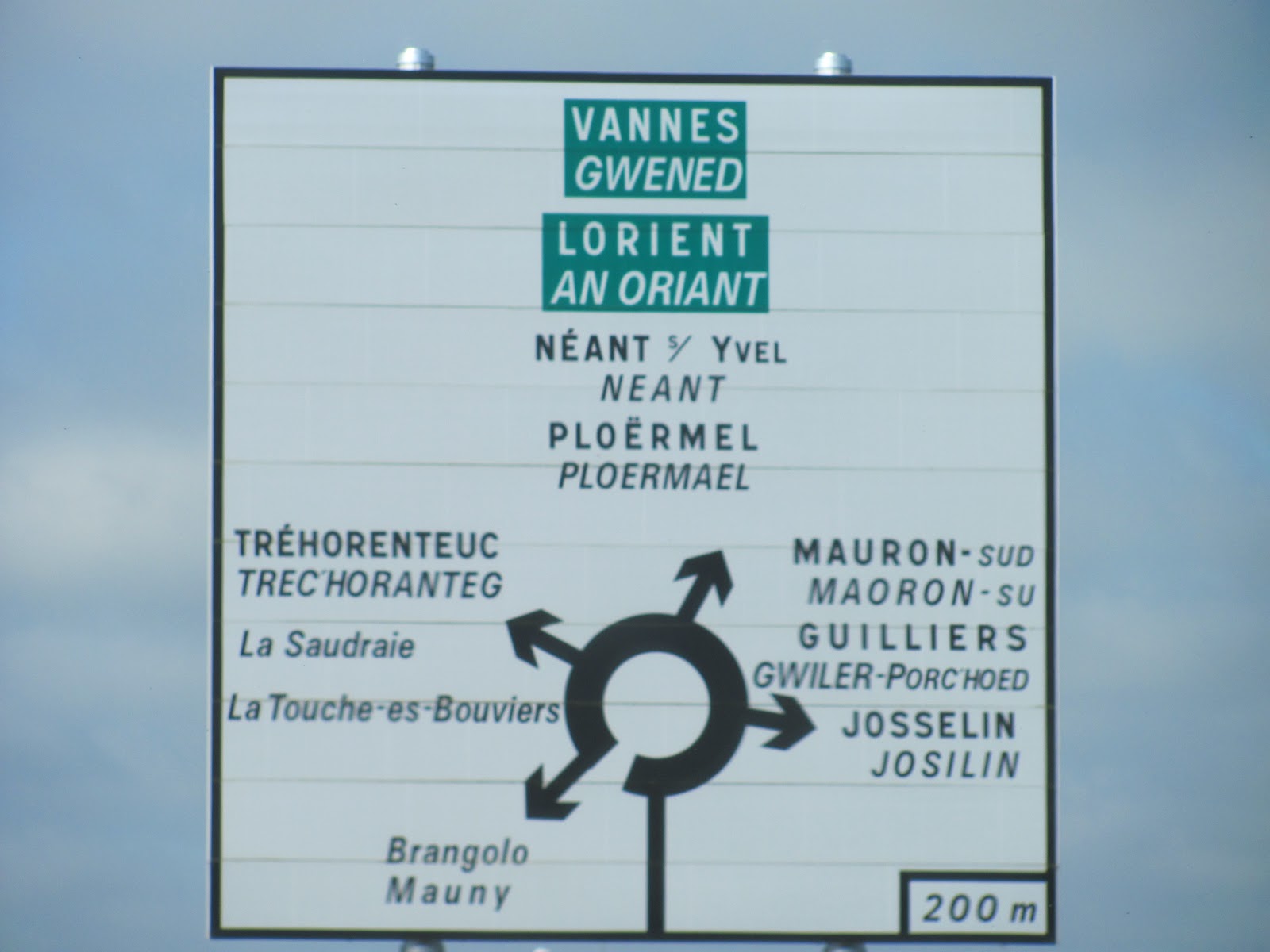
 As we got deeper into Brittany, we noticed that highway signs were written both in French and Breton (Celtic). 

We drove southwest through lots of rural countryside to Carnac, home of miles of standing stones.  We programmed Helen and made it to the town center at 12:00 and went straight to the tourist center.  The first set of doors was locked, but we could see people inside, so we went around to the other set of doors, and Leon opened the door to go in.  The young man behind the counter said that they were closed.  We asked when they would open again…2:00.  The sign outside said that they were open 24 hours.  The young man was kind enough to give us a map anyway.  We walked back outside in time to see all the shopkeepers moving their wares inside and pulling the gates across the shop doors.  We had forgotten that French small towns close up shop from 12:00 – 2:00 every day.  We decided to have lunch in what looked like a popular restaurant.  I ordered a Coke (no Pepsi to be found) and asked if it would be served with ice (also hard to find in France).  The waiter said that it would be served with ice, and indeed, it did have two ice cubes in it.  I figured that since we were American, they fixed it special for me – ice and no lemon slice floating on the top!


There is a beautiful church right in the middle of Carnac.  Although we had driven around several churches, we had not been inside one yet, so took the opportunity to go in this one.  They were getting ready for a funeral (we assume) since there were lots of mostly white floral arrangements being brought in.  We did not stay long, but did enjoy the beautiful stained glass windows.  The ceiling was painted wood and just gorgeous.


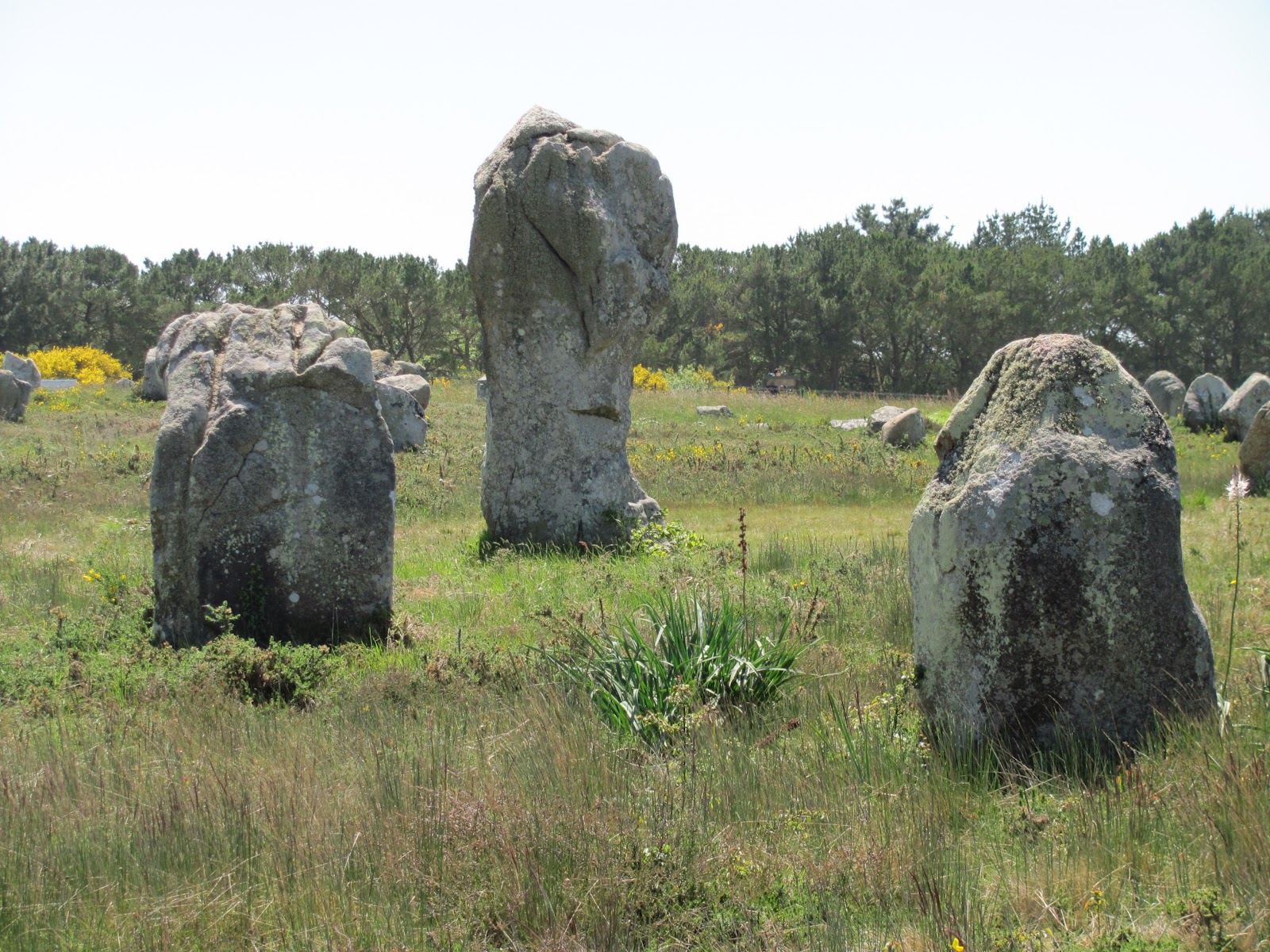
We drove just a little distance outside town and parked the car across from a field that was full of the stones.  Around here, they are called menhirs, megaliths, or “The Alignment.”  Since this is tourist season, we were not allowed into the field to get up close, but could walk completely around one of the fields on a little path.  The stones are in somewhat straight lines.  Some of the stones are only 3 feet tall, but others go up to 13 feet.  There are only about 3,000 of them left, but scientists estimate that there were originally about 10,000.  We saw some that had been moved to make a fence around somebody’s back yard, and some had been used to mark off a parking lot.  Apparently it has only been in the last 100+ years that the stones have been protected.  Before that, if you could haul them away, you could use them however you wanted.  Some of the stones weigh several tons.  The bottoms were only buried about 2 feet deep, so through the centuries, some of them have fallen over.


We looked on the map from the tourist office, and saw a photo of what looked like brown stones piled on each other and thought we would drive down toward the coast to see what they were.  There were no words by the photo, just these roundish brown “stones” that looked interesting.  We drove down the road and found out that there were no stones down there…it was a place where you could dig your own oysters!  Duh…we can’t tell the difference in rocks and oysters!

Back on the road again,  Leon decided to drive down by the Atlantic beach area.  There are tons of condos and hotels and apartments, none of them look very new and mostly older people were walking around.  We heard only French spoken there, so decided that it was a vacation spot for the older set.  We even saw a dirt lot where 3 different games of boule were being played…all older men having a great time.
 This hotel is for Diana! This beach is directly across the street...nice Atlantic beach!


We knew that there were some dolmen in that area, too, so drove around until we found some.  These are the upright stones covered with horizontal slabs that weigh several tons.  They were probably funerary rooms where the dead were buried.  We found 3 in one spot.  One was completely buried in the ground with steps down to it, and the other two were only half buried.  


We noticed that in most of Brittany the houses have black slate roofs, even the new houses.  We saw lots of new subdivisions as we drove down to Carnac (a little over 2 hours from our hotel).  We were wondering if France’s entry in the EU and change to the Euro had made more money available for housing loans.  There are new houses all over the place, and we think that the ones in the center of Brittany and farther south are not vacation homes like they are on the English Channel beach areas.  


As we drove back to our hotel, we decided to just stop at a McDonald’s for supper since we were tired and did not want to have to go to a restaurant for dinner.  We always like to go to a McDonald’s just to see what they have.  When I was teaching, I always got a Happy Meal to bring back so the school kids could see what was available in other countries, but now we can just eat anything.  They offer a McBaguette that is two burger patties laid side by side with cheese, lettuce, and spicy mustard on a baguette.  Leon ordered fries with his…McD’s fries taste the same all over the world.  We are always tickled that the drive-in is called McDrive.


There is a lot of agriculture in the middle of Brittany.  We saw dairy cows, both Holstein and Ayrshire.  The white cows we saw earlier in Normandy were Charolais and are mostly beef cattle, I think.  There were acres and acres of wheat, and some other fields had strips of plastic laid down with crops planted through the plastic.  I assume that keeps down the weeds.  The plants looked like corn.  We saw a few wind turbines, but not the hundreds that line every hilltop in Spain.
 Tomorrow we leave this wonderful manor house and start on our journey south.